The Pathfinder Bottleneck
Most organisations begin AI adoption with a few pilots. By the time those pilots deliver results, the landscape has already moved. What enterprises need is a continuous stream of pathfinders.
Many enterprises are accidentally slowing their own AI adoption.
There is a pattern I keep encountering that I would call the pathfinder bottleneck.
Most organisations quite sensibly begin their AI journey with a small number of pilots. Pathfinders. The logic is straightforward. Test safely. Learn what works. Then scale.
In practice, something different happens.
When learning cycles lag behind the technology
These pathfinders often take four to six months to deliver meaningful outcomes. By the time the results arrive, the landscape has already moved.
Consider what actually happened in the three months between December 2025 and March 2026.
What changed in 90 days
A pathfinder that kicked off in September 2025 would have scoped its architecture around a specific set of model capabilities, pricing assumptions, and integration patterns. By March 2026, the ground had shifted under every one of those assumptions.
Model capabilities leapfrogged. February 2026 alone saw twelve significant model releases: Claude Opus 4.6, Gemini 3.1 Pro, GPT-5.3 Codex. Gemini 3.1 Pro more than doubled its predecessor's reasoning score. A pilot designed around GPT-4o's limitations is now working within constraints that no longer exist.
Context windows expanded tenfold. Claude moved from 200K to 1M tokens in beta. A pathfinder that spent weeks engineering document chunking pipelines to work within 100K token limits made an architectural decision that is now unnecessary. The constraint changed. Not the prompt: the architecture.
Integration standards emerged. The Model Context Protocol went from niche to mainstream in Q1 2026. Organisations that built custom tool integrations in their pilot are now maintaining bespoke code that an MCP adapter would replace in days.
Agentic frameworks matured. LangGraph, CrewAI, AutoGen, and Microsoft's Agent Framework all shipped production-grade releases. A pilot that hand-wired a two-step agent chain in October 2025 is competing with off-the-shelf orchestration that includes state management, telemetry, and governance.
Entire tool categories face obsolescence. GitHub Copilot, the tool that defined AI-assisted coding eighteen months ago, is increasingly overshadowed by agentic coding environments like Claude Code that don't suggest lines but architect, refactor, and ship entire features within governed workflows. A pathfinder that evaluated Copilot in Q3 2025 evaluated a tool category that is being replaced, not updated.
Cost-performance ratios collapsed. API pricing dropped while capability increased. The cost-benefit analysis from six months ago is based on pricing that no longer exists for models that have been superseded.
Every one of these is a real architectural, cost, or capability assumption that changed between when a pathfinder started and when it delivered results. This is the operating environment for enterprise AI.
A six-month pilot scoped against today's constraints is a three-month pilot that spent three months learning about yesterday.
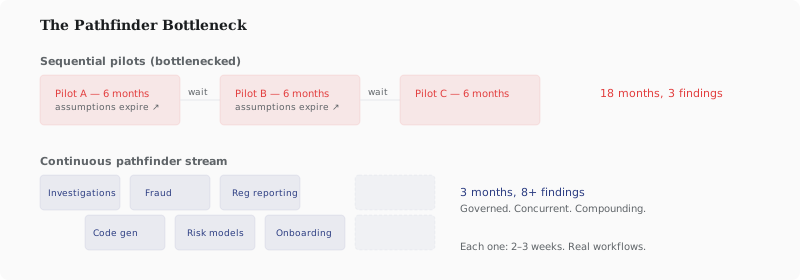
The bottleneck in its clearest form
A small number of initiatives become responsible for generating all of the organisation's learning about AI. Each one takes months. Each one scopes around assumptions that shift while the work is in flight. By the time the learning arrives, it is partially outdated.
Meanwhile, employees are already experimenting independently. Workflows are quietly evolving. New risks are appearing. The pathfinder programme is learning about yesterday's capabilities.
The question I keep coming back to is whether the learning mechanism can match the pace of the technology itself.
Continuous discovery, not sequential pilots
The alternative is a continuous stream of pathfinders. Not one at a time. A pipeline.
These pathfinders should be:
- Smaller in scope: two to three weeks, not six months
- Faster to launch: governed but not gated by a central programme
- Distributed across teams: investigations, fraud, compliance, platform, operations, not centralised in an innovation lab
- Focused on real workflows: real data, real users, real production constraints
Each initiative generates practical insight:
- Which tasks are most effectively augmented?
- Where does productivity genuinely improve?
- Where do governance or compliance concerns surface?
- What skills do people actually need?
- Which assumptions became obsolete while we were working?
That last question matters most. A continuous stream of pathfinders generates learning about the pace of change itself. The organisation develops a sense for how quickly the ground is moving, which is as valuable as any individual finding.
How this works with governed engineering
Running many concurrent experiments raises a natural question about coherence. Multiple teams, different tools, different approaches. The answer lies in the two-speed model: a strategic layer that provides governed engineering disciplines, and a tactical layer where the pathfinders run. Each pathfinder operates within architectural boundaries that ensure reversibility, observability, and auditability. The strategic layer provides the coherence. The pathfinders provide the learning.
In practice, this means each pathfinder:
- Uses governed delivery pipelines: AI-generated artefacts are validated before entering any system
- Operates within bounded contexts: each pathfinder has clearly defined domain boundaries
- Produces auditable outputs: every AI decision has provenance, every experiment has a traceable outcome
- Contributes reusable patterns: what works in one pathfinder becomes an engineering asset for the next
This is AI-Native Engineering applied to the adoption problem itself. The same principles that govern how we build AI systems (reversibility, observability, domain alignment) also govern how we learn about them.
Organisational AI memory
Over time, these pathfinders accumulate into something concrete. A body of engineering artefacts: working prototypes, governance precedents, performance benchmarks, integration patterns, model evaluation data, and documented failure modes.
This is organisational AI memory. It is stored in code, in architecture decision records, in governed pipelines, and in the practical experience of the teams who ran the experiments.
The tenth experiment is faster than the first, because the platform got better at supporting them.
Organisations that build this memory early compound their advantage. Each new pathfinder starts further ahead because the previous ones produced reusable assets.
The learning engine
Traditional enterprise transformation relies on a sequence of pilots. Enterprise AI adoption requires a learning engine.
A system where pathfinders continuously generate insight that feeds into platform development, governance evolution, capability growth, and new opportunities. Not waiting for one to finish before starting the next. Running them in parallel. Governed by architecture. Compounding through reuse.
The organisations that gain real advantage from AI will treat adoption as a continuous engineering discipline: one that runs at the same pace as the technology it is trying to adopt.
Managing Director
Managing Director and Chief Scientist at Bugni Labs. Platform engineering, AI-native systems, and architecture for regulated enterprises. 20+ years building systems in complex, high-stakes environments.