Enterprise AI Needs Two Speeds
Enterprise AI adoption requires two concurrent velocities: strategic architecture that holds for years, and tactical experimentation that delivers insight in weeks. Most organisations only have one.
Enterprise AI runs at two speeds simultaneously.
The first is strategic. Where does AI belong in your architecture? How do you govern it? What are the boundaries between human judgment and machine participation? These questions demand durable answers. Answers that hold for years, not quarters.
The second is tactical. Which workflows benefit from AI right now? Can your investigations team extract evidence faster with AI-assisted correlation? Can your regulatory team generate narratives with provenance in hours instead of weeks? These questions demand speed. Small experiments. Fast feedback. Real data.
Most organisations try to answer both with the same programme. In my experience, that rarely works.
Strategy without experimentation produces plans that age faster than they ship.
When strategy leads alone
When AI adoption is led by a strategic programme, it tends to slow down.
Architecture reviews. Governance frameworks. Vendor evaluations. Risk assessments. Each necessary. But when they gate every experiment, the organisation learns nothing while it plans.
I watched this happen recently. A programme launched with an "AI Centre of Excellence" and spent six months defining a target operating model. During those six months, Claude went from 200K to 1M token context windows. MCP emerged as an integration standard. Agentic coding tools made Copilot look like autocomplete. By the time the operating model was ready, it was designed for a world that no longer existed.
Thorough. Well-governed. And twelve months behind the organisation it was trying to govern.
When experiments lead alone
When AI adoption is led by bottom-up experimentation, something different happens.
I worked with a team where a fraud detection prototype was built on a model that was superseded before it reached production. A compliance team in the same organisation had integrated an LLM through a custom API wrapper that MCP would have replaced with a standard adapter. A platform team was evaluating Copilot for code generation while agentic coding environments were making the entire category obsolete.
Each experiment was rational in isolation. Together they produced a divergence: in standards, in tooling choices, in governance approaches, in architectural patterns. The question "how is AI governed here?" had no coherent answer, just a collection of well-intentioned prototypes.
The energy was there. The coherence was missing.
Two speeds, one system
What enterprises need is both layers. Running simultaneously. Connected by architecture.
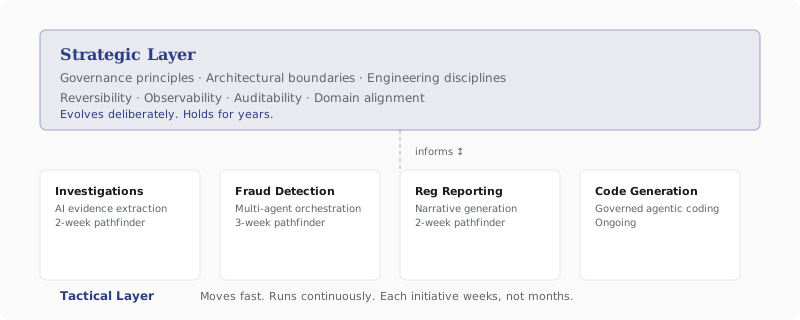
A strategic layer defines the architectural boundaries, governance principles, and engineering disciplines that make AI safe for enterprise use. In practice, this means engineering facets that every AI-participating system must exhibit: reversibility (every AI action can be undone), observability (every decision is traceable), auditability (every output has provenance), and domain alignment (AI operates within clearly bounded contexts).
This is what AI-Native Engineering provides. The framework that makes the experiments safe to run, adopted from the start, evolving with each engagement.
And a tactical layer runs continuous, small experiments within those boundaries. Each one tests a specific hypothesis about how AI changes a real workflow. Each one takes weeks, not months. Each one produces engineering artefacts (working code, performance data, governance findings) not slide decks.
The two layers inform each other. Experiments reveal what the strategy needs to accommodate. Strategy provides the guardrails that make experiments safe.
What this looks like in practice
In a regulated financial institution, the strategic layer might include:
- A governed delivery pipeline where AI-generated code is validated before it enters the codebase: every artefact traceable, every decision auditable
- Architectural principles that ensure AI participation is reversible: if a model underperforms or a regulation changes, the system falls back without human intervention
- An observability stack that makes AI behaviour visible: not just outputs, but reasoning chains, confidence levels, and the data that informed each decision
The tactical layer runs inside those boundaries:
- An investigations team tests whether AI can extract and correlate evidence from fragmented systems, as a governed service with full provenance. Two-week cycle. Real data. Production-grade evidence model.
- A fraud operations team experiments with multi-agent detection: diverse signals orchestrated through a single auditable layer. Three weeks. Real transaction data. Explainable outputs.
- A regulatory team uses AI to generate compliance narratives with structured evidence, as an audited automation with human-in-the-loop validation. Two weeks. Real regulatory submissions.
- A platform team uses agentic coding within governed blueprints: AI generates service scaffolding, human engineers own domain logic and architectural decisions. Ongoing. Measurable velocity improvement.
Each initiative is small. Each is governed. Each produces knowledge that feeds back into the strategic layer. And each can be stopped, reversed, or redirected without disrupting the others.
The compounding effect
Over time, this model produces something more valuable than any individual AI capability.
It produces organisational AI memory. A practical understanding (built through real delivery, not workshops) of how AI works inside the business. Which models perform for which tasks. What governance patterns actually hold under production pressure. Where the real productivity gains are. Where the risks materialise.
Those that take a sequential approach may find that by the time the answers arrive, the questions have already evolved.
Organisations that build this memory early will compound their advantage. Each experiment starts further ahead because the previous ones produced reusable patterns, governance precedents, and engineering assets.
Managing Director
Managing Director and Chief Scientist at Bugni Labs. Platform engineering, AI-native systems, and architecture for regulated enterprises. 20+ years building systems in complex, high-stakes environments.